
How to Organise a Duck Race
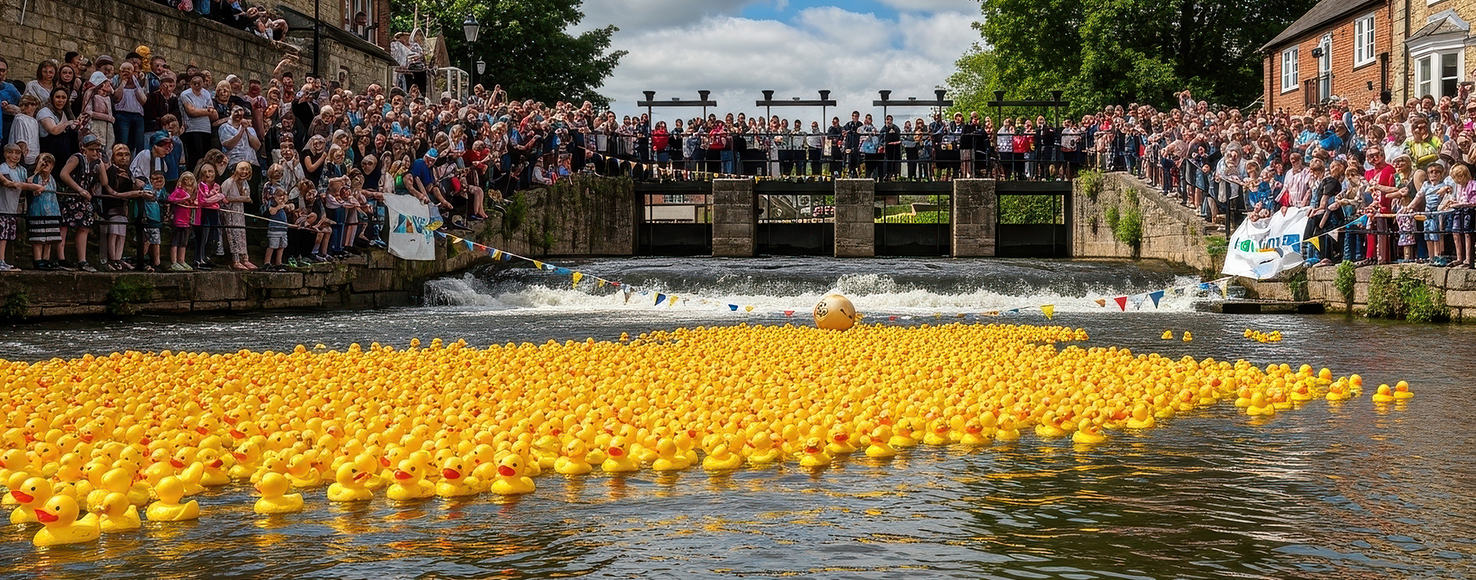
A rubber duck race is one of the simplest and most reliable fundraisers there is. A few hundred numbered ducks, a stretch of moving water, and a crowd on the bank. No performers to book, no catering to organise, and almost everyone already understands it.
It is also, legally speaking, a lottery. That surprises most first-time organisers, and getting it wrong is the one part of a duck race that can cause real trouble. This guide covers the rules properly, along with everything else you need: choosing your water, working out how many ducks, pricing tickets, and running the day itself.
We have been supplying duck race ducks across the UK for over fifteen years, for everything from village fêtes with a hundred ducks to races of more than ten thousand.
First, the legal bit
A duck race is a lottery. People pay to enter, there is a prize, and the winner is decided purely by chance. Under the Gambling Act 2005 that is the definition of a lottery, and it means you cannot simply sell tickets and hope for the best.
The good news is that there are two routes, both designed for exactly this kind of event, and neither requires a Gambling Commission licence. Which one you need depends on when and where you sell your tickets.
Route one: an incidental lottery
This is the simpler option, and it suits most village fêtes, summer fairs and school events.
An incidental lottery is one that runs as part of a larger event. The duck race cannot be the main attraction; it has to sit alongside something bigger, like a fête or a gala day.
The rules:
- No registration required. You do not need to tell anyone in advance.
- Tickets can only be sold at the event, on the day. No advance sales, no selling online, no tickets in the local shop the week before.
- The draw must happen at the event. Which for a duck race is the race itself, so that takes care of itself.
- No rollovers. All prizes are given out on the day.
- Maximum £500 spent on prizes, and maximum £100 deducted for costs such as printing.
- Proceeds must go to charitable, sporting or cultural purposes, not private gain.
If you are running your duck race at a summer fête and selling tickets from a stall on the day, this is almost certainly your route, and there is nothing to apply for.
Route two: a small society lottery
If you want to sell tickets in advance, which most larger duck races do because it is how you build the pot, you need to register as a small society lottery.
- Register with your local council, specifically the licensing authority where your organisation’s principal office is. There is a fee, and registration has to be renewed annually.
- Allow at least 28 days. Do not leave this to the last fortnight.
- Maximum £20,000 of ticket sales per draw, and £250,000 across all your lotteries in a calendar year.
- No single prize worth more than £25,000.
- At least 20% of proceeds must go to the good cause. Prizes and expenses together cannot exceed 80%.
- Every ticket must cost the same, and must be paid for before the draw.
- Tickets can only be sold by and to people aged 16 or over. They cannot be sold in the street, though shops, kiosks and door to door are fine.
- You must submit a return to the council within three months of the draw, signed by two members aged 18 or over, setting out proceeds, prizes, costs and the amount that went to the cause.
Neither route is difficult. But the difference between them is entirely about advance ticket sales, and that is the thing to decide early, because it determines whether you need to register at all.
Please check with your own local authority before you commit to anything. Licensing is administered locally, fees vary, and this guide is general information rather than legal advice.

Insurance and permissions
Public liability insurance is essential, and if your race is part of a larger event, the organisers may already hold cover that extends to it. Check rather than assume. If you are running the race independently, you will need your own.
You need permission for the water. Rivers and canals have owners and managing authorities, and turning up with two thousand ducks is not something to spring on anyone. Depending on your location that may mean the landowner, the council, a canal trust, or the relevant environmental authority. Ask early, because this is the permission most likely to be refused or to come with conditions.
Write a risk assessment. Not because anyone enjoys it, but because moving water plus a crowd on a bank plus children is a genuinely risky combination, and because your insurer and your venue will both ask for it. Cover bank access, water depth and flow, where spectators stand, what happens if someone goes in, and who is responsible for what.
Getting your ducks back
Plan retrieval properly and it is straightforward. Leave it to chance and you will be buying ducks again next year.
In fifteen years of supplying races we have seen three approaches work well, and which one suits you depends mostly on scale.
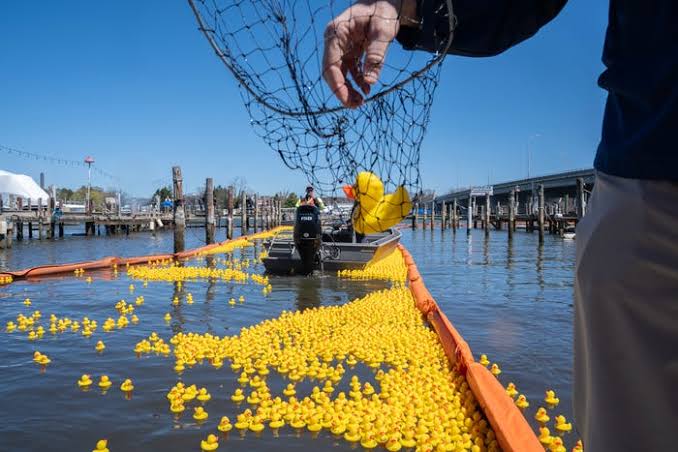
A net across the water at the finish, which doubles as your finish line. Simple, cheap, and ideal for smaller races on narrow water.
Volunteers with long-handled poles and nets stationed along the bank, freeing stranded ducks as they go and scooping them out at the end. Best on wider or slower stretches where ducks spread out.
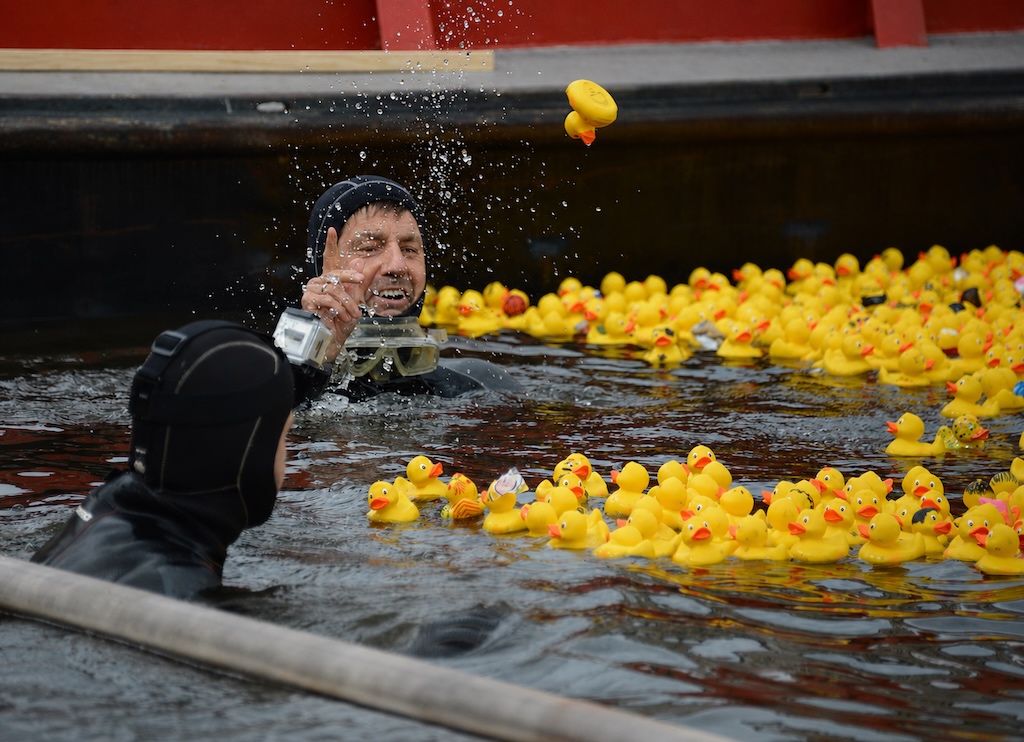
Kayaks. For larger races, a couple of paddlers gathering ducks downstream is both effective and rather good to watch. Several of the bigger races we supply do exactly this.
Whichever you use, give someone the job of counting the ducks back in. Not an afterthought, an actual named role.
Choosing your water
The ideal duck race course has:
Steady, gentle flow. Fast enough that ducks move without help, slow enough that the race lasts a couple of minutes rather than fifteen seconds. Too slow and you will have ducks stranded in the shallows and a crowd losing interest.
Clear access at both ends. You need to get ducks into the water in bulk at the start, and get them out again at the finish. A steep or overgrown bank makes both jobs miserable.
A visible course. Spectators want to watch. A stretch overhung with trees or hidden behind a wall kills the atmosphere.
No obstacles. Weirs, low bridges, dense reeds and moored boats all cause pile-ups and lost ducks.
A finish line you can control. Most races use a net stretched across the water. It catches the ducks, marks the finish, and makes the winning duck unambiguous.
No river? It does not stop you. Plenty of races run on a stretch of canal, a large pond with hosepipes or pumps to create flow, or even a purpose-built trough or channel for indoor and small-scale events. A children’s race down a garden stream works on the same principle as a ten thousand duck city centre event.
How many ducks do you need?
The honest answer is: more than you think, but fewer than you fear.
As a rule of thumb, one duck per ticket you expect to sell. Most races number each duck and sell that number as a ticket, so the two are the same figure.
Rough guide by event size:
- Small village fête or school: 100 to 250 ducks
- Town event or established annual race: 500 to 1,000
- Large charity or city centre race: 2,000 to 10,000 or more
Order more than you need rather than fewer. Ducks that do not race this year race next year, and running out of tickets on the day is a straightforward way to leave money on the bank.
If you are not sure what quantity suits your event, ask us. We have helped organise the supply for races of every size and we would rather help you get it right than sell you the wrong number.
What to look for in a racing duck
Not all ducks race well, and the differences only become obvious once they are in the water.
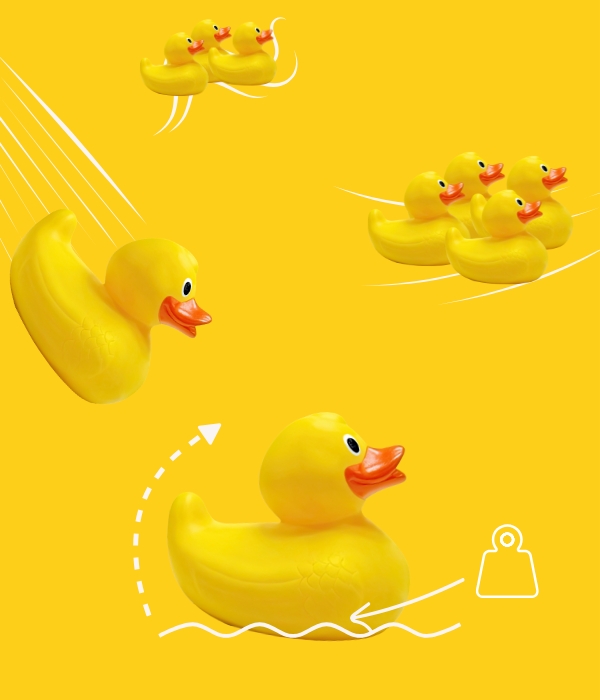
Weighted, so they float upright. This is the one that matters most. An unweighted duck tips onto its side, spins, and stalls in eddies, because a duck lying on its side does not catch the current. Our 8cm weighted racing ducks are weighted to sit upright and track straight.
Sealed, so they do not sink. Ducks with an open squeak hole take on water over the course of a race. A duck half full of river water rides low, slows, and eventually goes under, which is a problem when that duck carries someone’s ticket number. Ours are sealed.
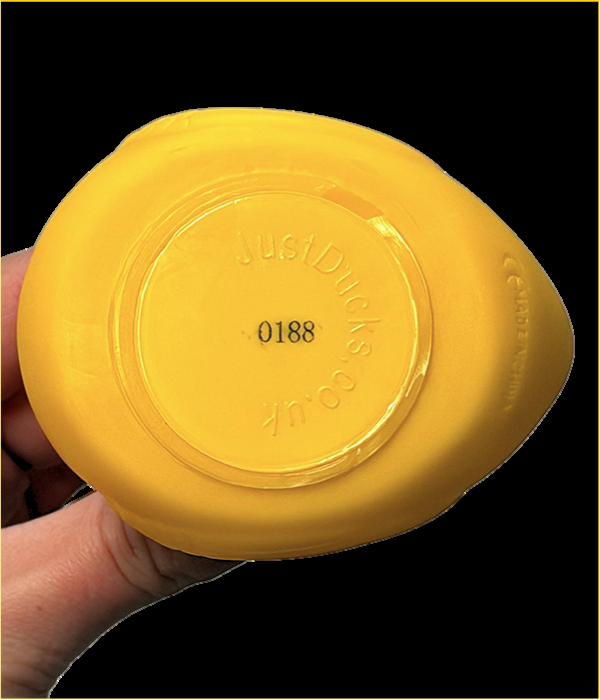
Numbered, so identifying the winner in a net of two hundred ducks is a five second job rather than an argument. At JustDucks we can supply your ducks sequentially numbered to save you all the work!
Made properly. Ours are moulded from phthalate-free vinyl, CE approved and produced to strict UK, EU and US toy regulations. That matters at a public event with children present, and not every cheap bulk plastic duck can say the same.
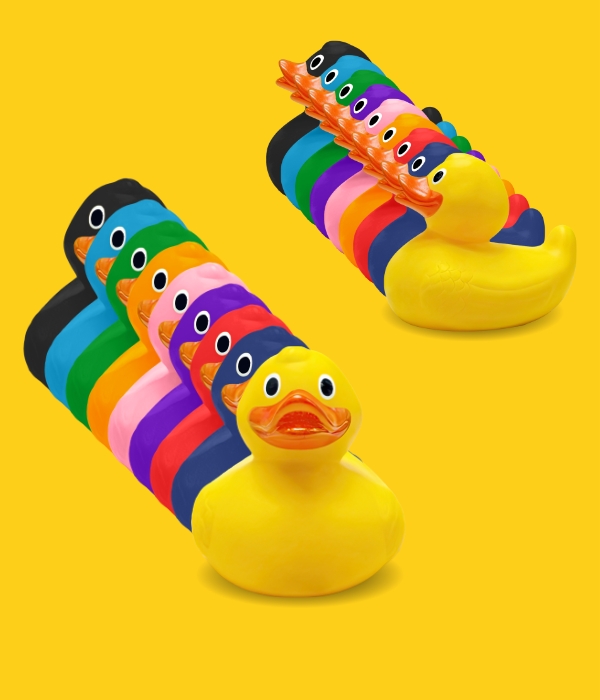
In stock, in colours. We keep racing ducks in stock in yellow, orange, pink, cyan, royal blue, green, red, black, white, purple, gold, silver and bronze, and we add new colours every year. Useful if you want teams, sponsor colours or a separate children’s race in a different shade.
And they last. Our ducks race year after year. Cheap ducks split, fade and fill with water, and get replaced annually. Cost per race matters far more than cost per duck.
Pricing tickets and making money
Duck races raise serious money for their size, which is why so many committees run one every year without fail. The costs are low, almost all of the work happens on one afternoon, and the ducks last for years, so the second race is cheaper than the first.
Set your own ticket price. You know your event and your crowd better than anyone, and duck race tickets sell readily because people are happy to pay for something that is both a donation and genuinely good fun to watch. Look at what comparable events near you charge, factor in the cost of your ducks and prizes, and price it so the race is worth running. Most organisers find people pay more willingly than they expected.
Sponsorship is where duck races become even more profitable. Local businesses will sponsor prizes, the finish line, or the race itself, and it costs them little. A duck race gives a sponsor something visual and family-friendly to be associated with.
Prizes do not need to be expensive. Remember the £500 prize cap if you are running an incidental lottery. Donated prizes from local businesses are common, welcome, and keep your costs down.
Sell more than one thing. Corporate sponsorship, blocks of ducks at a reduced rate, and a separate children’s race are all straightforward ways to increase the take without much more work on the day.
The best fundraising idea we have seen
This one is worth stealing.
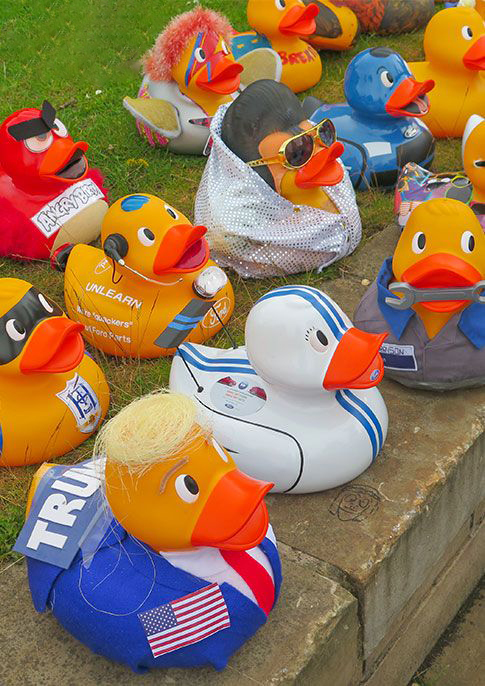
Several organisers we supply run a second, separate race using 32cm giant ducks, sold to local businesses as corporate sponsorships. Each sponsor gets a giant duck to hand decorate however they like, in their branding, as a mascot, or as something deliberately ridiculous. The decorated giants then race each other as a headline event later in the day.
It works for several reasons at once. Businesses will pay far more for a sponsored giant duck than an individual pays for a standard ticket. The decorating gives sponsors something to post about for weeks beforehand, which promotes your event for free. The giants are far more visible on the water, so the headline race is better to watch. And the sponsors turn up on the day with colleagues and families, who then buy tickets for the main race.
The organisers who do this consistently tell us it is the most profitable part of their event.
Running the race
Start together. The classic method is a large net, sack or hopper holding all the ducks, released in one go from a bridge or bank. A staggered start produces a strung-out procession rather than a race.
Number your ducks clearly and record who has which. A simple numbered list is enough. Do it before the day, not during it.
Station marshals along the course. Their job is to free stranded ducks, keep spectators back from the edge, and watch for anyone getting too close to the water. Give them poles or nets.
Commentate. This is the single biggest difference between a race people remember and a race people watch politely. Someone with a microphone calling the leaders, inventing rivalries and building tension turns two minutes of floating plastic into an event. It costs nothing.
Have the prize giving ready immediately. The crowd is there, the winner is there, and momentum dies fast once people start drifting off.
While you have a crowd
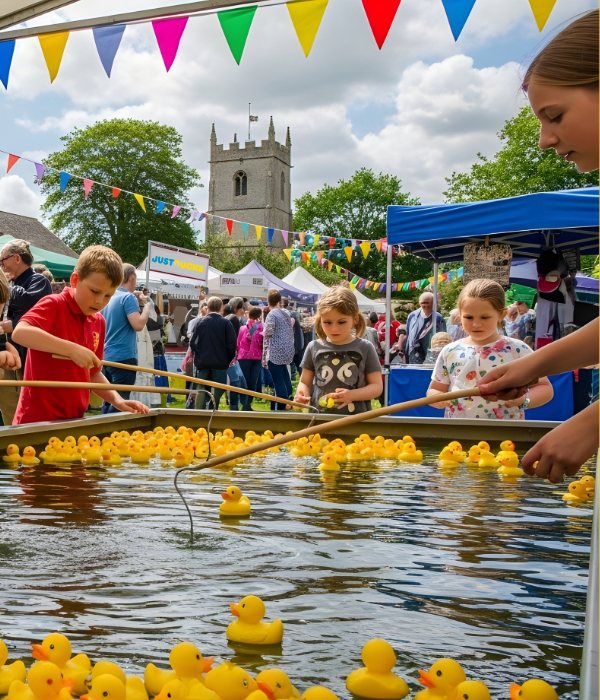
If your duck race is part of a fête or gala, the same crowd will happily spend money on a second attraction, and the obvious one shares your theme.
A hook-a-duck stall runs on the same principle, needs no water beyond a paddling pool or trough, and takes money continuously all afternoon rather than in one burst. Weighted ducks, rods and prizes are all you need, and unlike the race it does not count as a lottery, so there is nothing to register.
Plenty of organisers run both, and the ducks are reusable next year either way.
When to order
We can ship next day, so you are not stuck if plans change late.
That said, order as early as you reasonably can. The summer months are our busiest by a wide margin, because every fête, gala and village show happens in the same twelve weeks. Securing your ducks early means the colours and quantities you want are there when you need them, rather than whatever is left in July.
For quantities over 200 we offer scaled discounts, and for very large orders we quote per event depending on the numbers. Get in touch with your quantity and date and we will come back with a price.
Common mistakes
Leaving the licensing until the last minute. If you need to register as a small society lottery, you need 28 days. Discovering that a fortnight before the event is a bad week.
Leaving the licensing until the last minute. If you need to register as a small society lottery, you need 28 days. Discovering that a fortnight before the event is a bad week.
Buying cheap unweighted plastic ducks. This is the mistake we see most often, and the one organisers regret most. Cheap bulk plastic ducks are not weighted, so they tip onto their sides and refuse to travel. They are often not sealed, so they fill and sink. They are not always phthalate-free, which matters at a family event. And they do not survive to race again.
A great many of our customers came to us after trying the cheap option once. The race was a disappointment, the ducks were unusable the following year, and they replaced them with weighted, sealed racing ducks that have run every year since. The saving on the first order rarely survives contact with the water.
Not planning retrieval. Ducks vanish downstream, and you buy them again next year.
Too few ducks. Running out of tickets at midday when the crowd is still arriving and wanting to add last minute entries.
Rubber Duck Racing FAQs
Not a Gambling Commission licence. But a duck race is a lottery, so you need either to run it as an incidental lottery, which requires no registration but means selling tickets only at the event on the day, or to register with your local council as a small society lottery, which allows advance ticket sales. Check with your own council before committing.
Only if you have registered as a small society lottery with your local licensing authority. If you are running an incidental lottery, tickets can only be sold at the event itself.
Roughly one per ticket you expect to sell. Village fêtes typically use 100 to 250, town events 500 to 1,000, and large city races several thousand. We have supplied races of more than ten thousand.
That is up to you, and it varies a lot by event and area. Duck races reliably raise strong sums because people are happy to pay for something that supports a good cause and is enjoyable to watch. Look at what comparable local events charge, factor in your ducks and prizes, and price it so the race is worth the effort.
Yes. Unweighted ducks tip over, spin and float on their sides, which makes for a poor race. Weighted ducks sit upright and travel properly with the current. A lot of cheap plastic offerings available are not CE approved or Phthalate free, unlike our ducks which are.
Yes, and most organisers do. Sealed, weighted ducks made from proper vinyl race for years, so your second race costs far less than your first.
Yellow, orange, pink, cyan, royal blue, green, red, black, white, purple, gold, silver and bronze, with new colours added every year.
Yes. Over 200 ducks we offer scaled discounts, and very large orders are quoted individually. Send us your quantity and date via the form on our duck racing page.
We can ship next day. We do recommend ordering early for summer events though, because that is when most races happen and demand is heaviest.
Canals, ponds with pumped flow, and purpose-built channels or troughs all work. The race needs moving water, not necessarily a river.
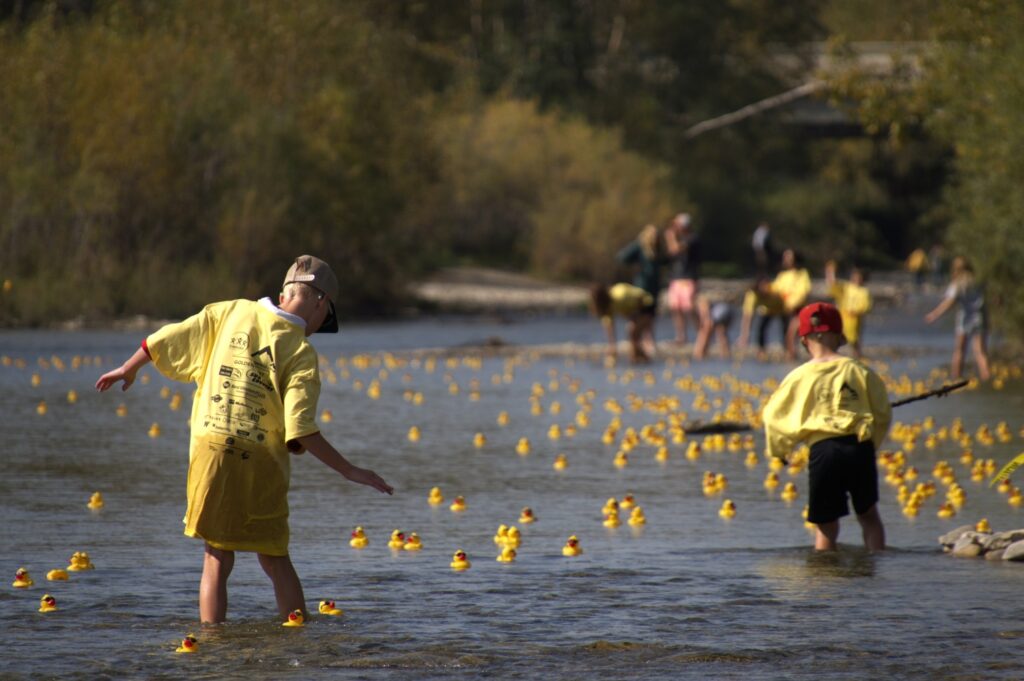
Most last two to five minutes over a course of 50 to 200 metres, depending on flow. Aim for long enough to build tension and short enough to keep the crowd.
Yes. Our ducks are CE approved and comply with strict UK, EU and US toy regulations.
Every product we produce is phthalate free, we can also ship the ducks packaging free in cardboard mesh if that fits your needs.
We can supply certification paperwork, including CE declarations and test reports, on request. Just ask and we will sort it for your compliance records.
Yes. We supply ducks to races worldwide, just drop us a message or order through our site and delivery will be automatically calculated.
Order your race ducks
We supply weighted, numbered, sealed ducks for races across the UK, from a hundred to ten thousand and beyond, in thirteen colours, and we have been doing it for over fifteen years.
See our duck race ducks or tell us about your event and we will help you work out exactly what you need.